
What we do
Patios
Patios, walkways, entries and stoops, from a plain broom finish to exposed aggregate. Poured over a base we built ourselves, with the fall worked out before the forms go up.
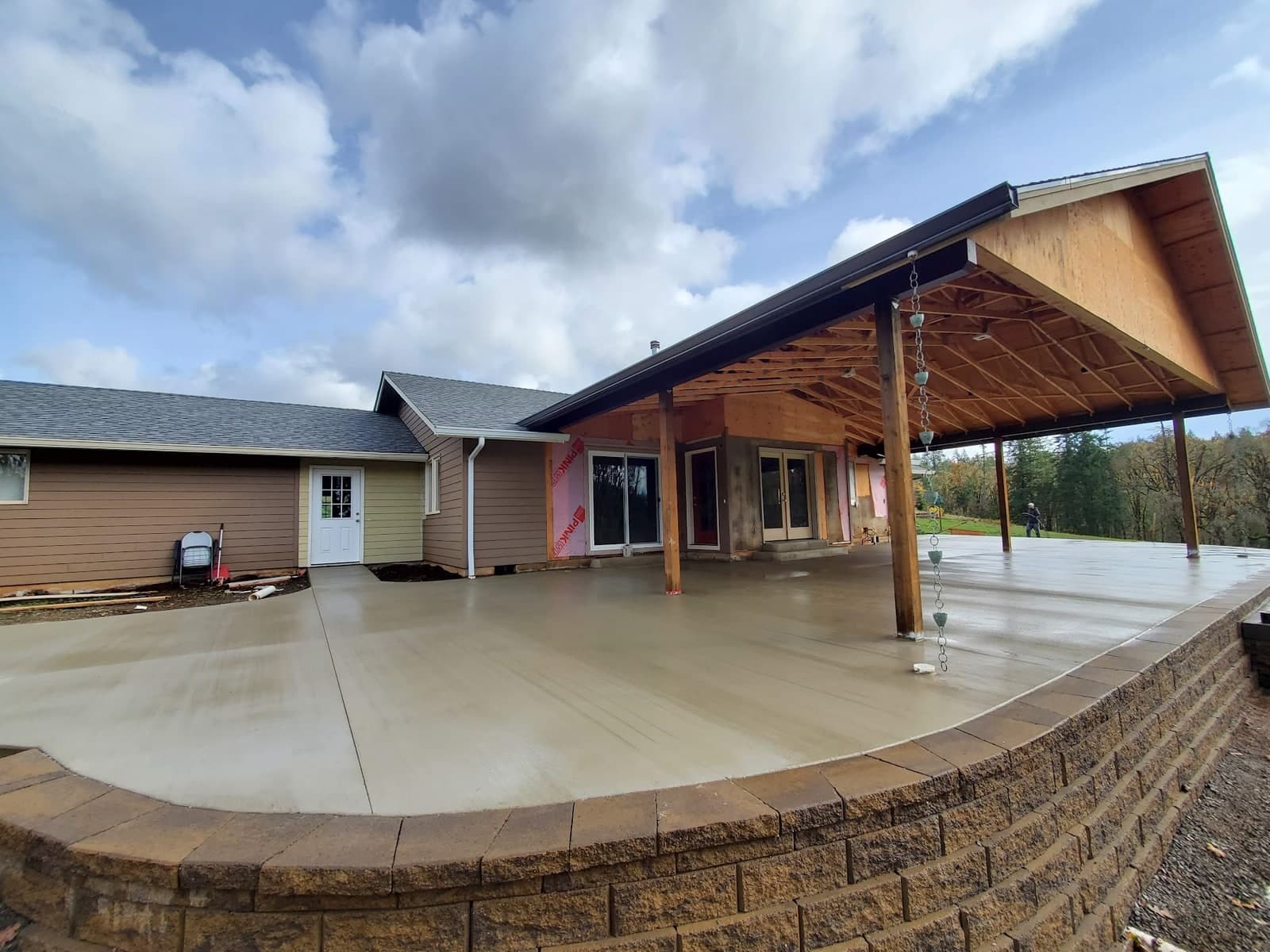
A patio is a flat surface in daylight with no structure to hide behind, so the joints, the fall and the finish are all anybody ever sees. We pour patios, walkways, front entries and stoops, and we treat where the water goes as the first decision rather than the last one. On a slab poured against a house that matters more than the finish does: the surface has to move water away from the foundation and stay free to move independently of it, and a patio that drains back at the building is the most expensive thing on this page to get wrong and the most common. Everything we place goes over a base we prepared and compacted ourselves, which is the part that decides whether the slab is still flat in ten years. On finishes, you have real choices and they change the price: broom is the workhorse, exposed aggregate gives you texture and grip, and stamped and color work are available where the job suits them. Patrick's own description of a recent Newberg job is the shape of it — a new exposed aggregate patio, front entry, sidewalk and stoop, finished to last. Tell us what the space is for and how you want to use it, and we will tell you what the ground under it is going to need first.
What is included
- Patios, walkways, front entries and stoops, poured over a base we compacted
- Fall and drainage set before the forms go up, not discovered after the first rain
- Broom, exposed aggregate, stamped and color finishes — priced honestly, up front
Our process
How patio jobs run
Mark it out on the ground
We paint the shape on the ground and have you walk it before anyone digs. People move things two feet at this stage all the time, and it costs nothing here.
Set the fall first
Where the water goes gets decided before the forms, especially against a house. This is the single most common thing to get wrong on a patio and the most expensive to fix afterwards.
Base, forms and steel
Base rock to depth and compacted, forms set to the fall you agreed, and mesh or bar where it is called for. The finish you chose changes what happens here, so it is settled before the pour.
Pour, finish, joint and clean up
Screed, float, finish to the texture you chose, then saw-cut the joints on a spacing that suits the slab. The site gets swept and blown off before the crew leaves.
Our work
Recent patio work
Questions
Questions about patio work
Yes, and the important part is the fall and the joint where the slab meets the building — the surface has to move water away from the foundation and stay free to move independently of it. If your existing patio currently drains toward the house, that is fixable and it is worth fixing at the same time. Call (503) 840-8634 and we will come and look at it.
Broom is the standard and it is the right answer more often than people expect — it wears well and it is not slippery. Exposed aggregate gives you texture and a bit more grip. Stamped and color work are options too, and they suit some patios and not others. Each one changes the number, and you will see by how much before you pick.
Because almost every patio failure people blame on the concrete started underneath it. A slab that cracked in a line or settled at one end usually did that because the base was thin, uncompacted, or sitting on ground that holds water. We dig and compact our own base, which means the person who prepared the ground is the person who has to live with what gets poured on it.
Get a free on-site estimate
Tell us what you are looking at and we will come and measure it. No obligation, no pressure, and a written itemised quote rather than a number on the back of a card. We usually respond the same day.
Call (503) 840-8634- Hours
- Mon - Fri 7:00 AM - 6:00 PM
- Licensing
- Licensed • Bonded • Insured • CCB #251334
- Response time
- We usually respond the same day.