
What we do
Garages & Shop Floors
An interior floor is a different pour from a patio, and the difference is underneath the concrete. Garage slabs, shop and barn floors, and outbuilding slabs specified for the load that will actually live on them.
The short version is that an interior floor gets a vapor barrier and exterior flatwork does not. That one detail is most of the difference between a shop floor and a patio: a sheet of poly under the slab is what stops ground moisture coming up through the concrete and into everything stored on it, and it is not something you can add later. The other half is load. A floor holding hand tools and a workbench is a different slab from one holding a two-post hoist, a loaded trailer or a forklift — it needs different thickness, different reinforcement and a base chosen for that weight, and it needs to be flat in a way a back patio never has to be. Tell us the heaviest thing that will ever sit or turn on it and we will spec to that and put it in the estimate. We also pour floors with radiant in-floor heat, which is the one upgrade on this page that genuinely cannot be retrofitted: the tubing is tied to the steel over the vapor barrier and the slab goes on top of it, so it is either in the pour or it is never there at all. If that is something you are considering, raise it early — it changes the slab, not just the budget.
What is included
- Garage slabs, shop and barn floors, and outbuilding slabs over a proper vapor barrier
- Thickness, steel and base specified for the actual load — hoist, trailer or workbench
- Radiant in-floor heat poured in, which is the only time it can be done
Our process
How shop floor jobs run
What is going to live on it
The first question is the heaviest thing that will ever sit or turn on the floor. Everything else on this list is decided by the answer, and it is much cheaper to answer it now than to core a slab later.
Cut, base and compaction
The pad gets cut to grade and the base placed to depth and compacted in lifts. On an interior floor there is no drainage to bail you out, so the base has to be right.
Vapor barrier, steel and heat
Poly down, reinforcement set on chairs, and if the floor is getting radiant heat the tubing is tied to the steel now. This is the last moment any of it can happen.
Pour and finish flat
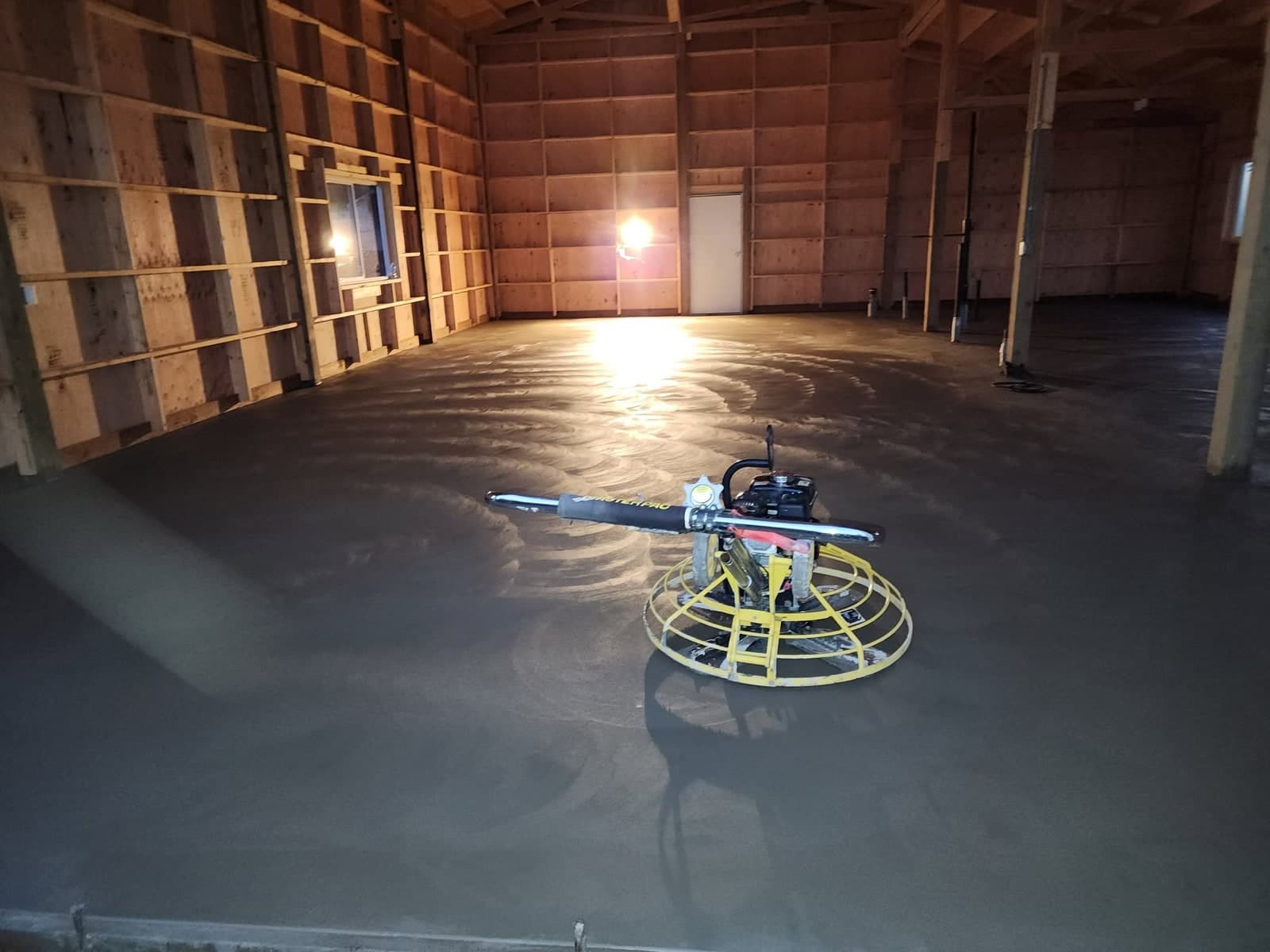
Placed, screeded and finished to a hard trowel where the use calls for it, with joints cut on a spacing that suits the slab and the building.
Our work
Recent shop floor work
Questions
Questions about shop floor work
It depends entirely on what lives on it. A floor holding hand tools and a workbench is a different slab from one holding a two-post hoist, a loaded trailer or a forklift. Tell us the heaviest thing that will ever sit or turn on it and we will spec the thickness, the reinforcement and the base to that, and put it in writing in the estimate.
If the space is enclosed and you are storing anything in it, yes. Ground moisture moves up through concrete, and without a barrier it will find whatever is sitting on the slab and whatever you eventually put down on top of it. It is a cheap layer at pour time and there is no way to add it afterwards.
No, and that is the whole reason to decide early. The tubing is tied to the reinforcement over the vapor barrier and the concrete is poured on top of it, so it either goes in with the slab or the floor does not have it. If you are thinking about it at all, say so on the estimate call — (503) 840-8634 — because it changes how the floor is built rather than just what it costs.
Get a free on-site estimate
Tell us what you are looking at and we will come and measure it. No obligation, no pressure, and a written itemised quote rather than a number on the back of a card. We usually respond the same day.
Call (503) 840-8634- Hours
- Mon - Fri 7:00 AM - 6:00 PM
- Licensing
- Licensed • Bonded • Insured • CCB #251334
- Response time
- We usually respond the same day.